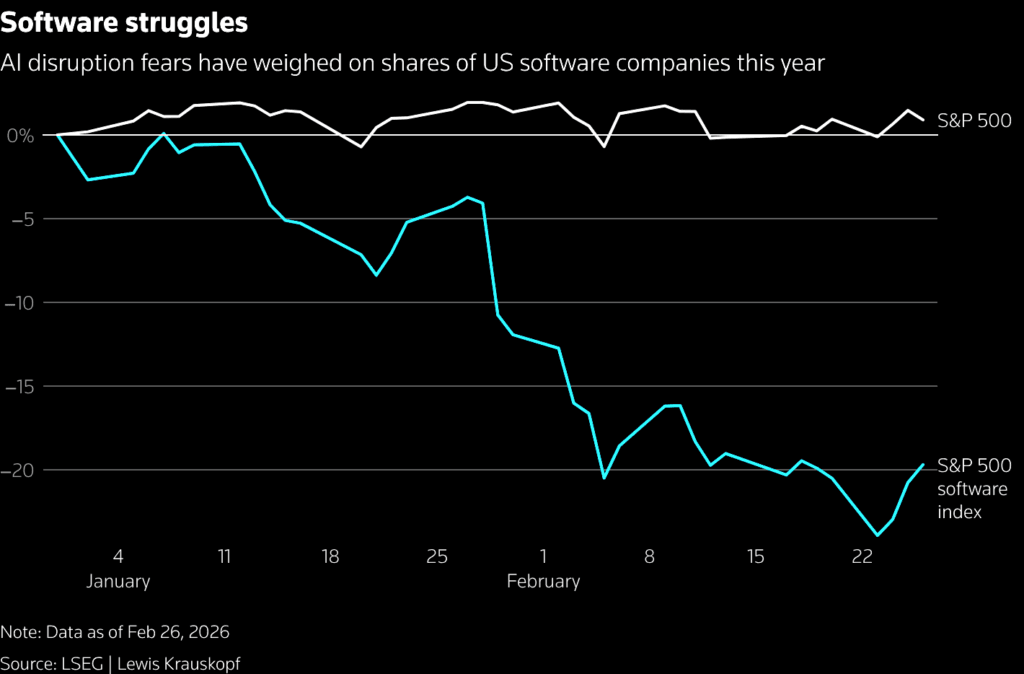
A recent Reuters market analysis highlighted a growing anxiety on Wall Street: artificial intelligence may fundamentally reshape the software industry. Investors are increasingly trying to determine which companies will benefit from AI and which ones may be displaced by it.
That uncertainty is already visible in the stock market.
Shares in sectors such as software, wealth management, and data services have been volatile as investors struggle to understand how AI will change existing business models. Some companies that once appeared unassailable are now being re-evaluated based on whether their products could be replicated or replaced by AI-powered tools.
In short, AI is not just changing technology. It is changing the economics of software itself.
For decades, the dominant model in enterprise software was scale. Large vendors built platforms that could serve thousands of companies at once. Businesses purchased licenses and adapted their workflows to fit the capabilities of the software.
Artificial intelligence is beginning to invert that model.
Modern AI-assisted development tools allow software to be created faster and tailored more precisely to specific business processes. Tasks that previously required months of engineering work can now be prototyped, iterated, and deployed in a fraction of the time. This dramatically lowers the barrier to building custom applications.
The implication is profound: software no longer has to be generic to be affordable.
This is one of the reasons investors are questioning traditional software valuations. If AI makes it easier to build specialised tools, the competitive advantage of large, monolithic software platforms may weaken over time.
For small and medium enterprises, however, this shift is largely positive.
Instead of forcing their operations to conform to rigid software platforms, businesses can increasingly deploy systems designed around their actual workflows, data structures, and operational needs.
This is precisely where smaller development teams have an advantage.
At Bynry Foundry, our approach is built around this new reality. Because we operate as a small, focused team, we can move quickly, iterate rapidly, and build software that reflects how a specific organisation actually works. Rather than delivering generic products, we build bespoke operational systems designed to solve real business problems.
In the past, custom software was often seen as expensive and slow. AI-assisted development is changing that equation.
As the software industry adapts to this new technological landscape, the winners may not only be the largest platforms. They may also be the nimble builders who can deliver precisely the tools that businesses need in a way that is cost efficient, quick and without added complexity.
That is the opportunity that AI is quietly creating.
Leave a Reply